
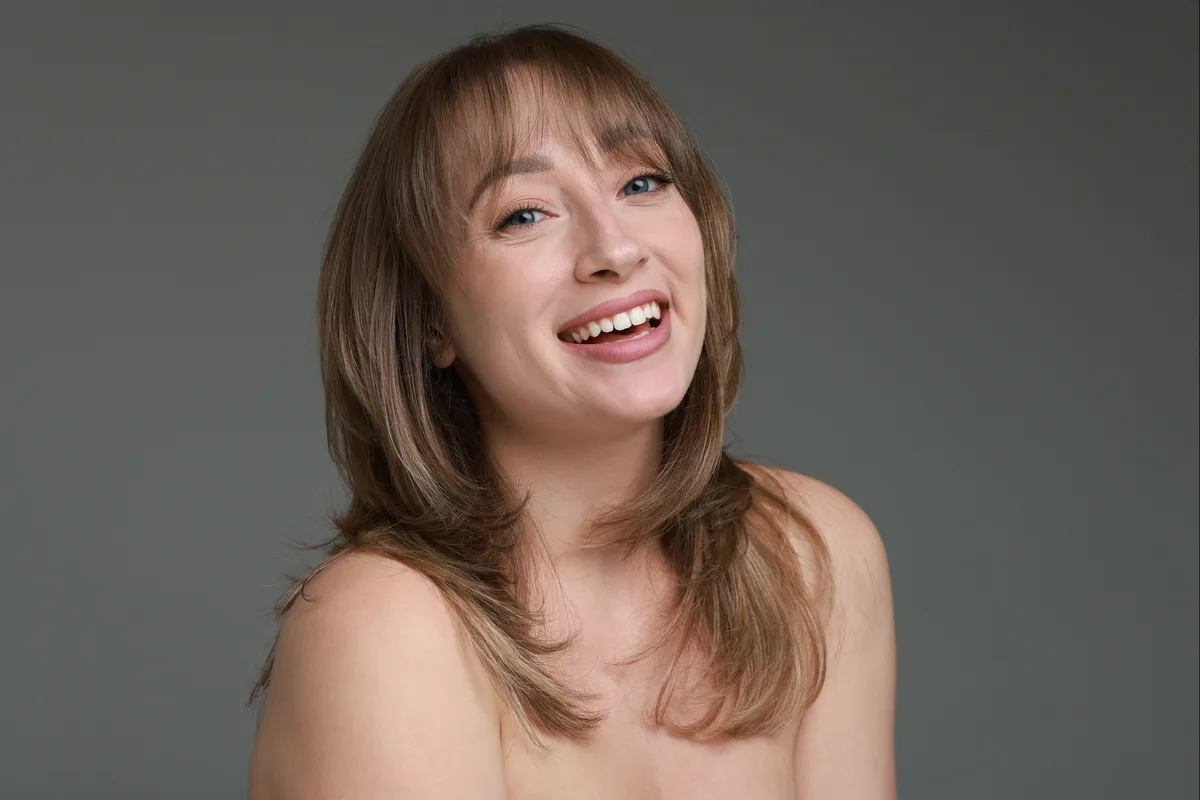
7 Curtain Bangs After 50: Soft, Not Severe
A fringe after 50 has a reputation problem. The blunt, heavy bangs many women picture — a solid shelf of hair sitting straight across the forehead — can harden features, crowd the eyes and date a haircut in a way little else does. Curtain bangs are the answer to that fear: parted in the middle, shorter at the centre and sweeping longer toward the cheekbones, they frame the face instead of covering it, and they stay soft at every step.
This gallery brings together seven curtain fringe looks photographed on women in their forties, fifties and early sixties. Six are real photographs licensed from Envato Elements; the final look is a clearly labelled AI visualisation, included because a silver curtain fringe is the version readers ask about most and the one stock libraries rarely photograph well. Every look passed the same test: a woman clearly in the 40–65 range, and a fringe that genuinely parts and sweeps — wispy, feathered and open, never a blunt straight line.
What Makes Curtain Bangs Soft, Not Severe
The parting does the softening. A curtain fringe is split at the centre (or just off it), so the forehead is never fully covered. That open middle is what separates it from the blunt fringe: skin shows through, the brows stay visible, and the face keeps its length.
Wispy beats dense. On finer, mature hair, a fringe cut too thick takes bulk the rest of the head cannot spare and lands heavily. Ask for a fringe that is thinned at the ends and feathered, so individual strands separate. The looks in this gallery are deliberately airy — a fringe you can see through slightly is the one that flatters.
Length is the safety net. Curtain bangs are longest where they meet the cheekbones and jaw, which means they grow out gracefully: no hard line appears at week three, trims can stretch to six or eight weeks, and if the fringe is ever regretted it simply becomes face-framing layers. Few cuts at this age are as forgiving.
Styling is measured in seconds. A curtain fringe asks for direction, not effort: blow-dry it forward, then sweep each side away from the face with a round brush or fingers, and let it fall open. It works with glasses, sits happily under a hat, and can be pinned back entirely on a no-fringe day — flexibility a solid fringe never offers.
Foreheads, glasses and cowlicks. A taller forehead is where a curtain fringe earns its keep: the open centre keeps the proportions balanced where a full fringe would shorten the face. Glasses wearers should keep the centre strands at brow length or a fraction above, so the fringe clears the frames instead of resting on them. A strong cowlick at the front hairline usually settles once the fringe has a little length and weight at the sides — one more reason to keep the outer pieces long rather than cutting the fringe short and hoping it behaves. And if the hairline itself is fine or sparse, a wispy curtain fringe is the kindest option of all: it suggests coverage without demanding density that is not there.
7 Curtain Bangs After 50: Soft, Not Severe
1. The Classic Curtain Fringe, Tapered to the Jaw

This is the reference version: a clean centre part, the shortest strands grazing the brows, then each side lengthening in a smooth taper until it meets the jaw. Worn here with the rest of the hair in a low ponytail, it proves the fringe works even when everything else is pulled back — the face stays framed and nothing reads severe.
Suits: most face shapes; anyone trying a fringe for the first time. Upkeep: low; fringe trim every 6–8 weeks. Ask your stylist for: a centre-parted curtain fringe, brow length in the middle, tapering to the jaw, ends feathered.
2. Wispy Curtain Fringe with Soft Layers
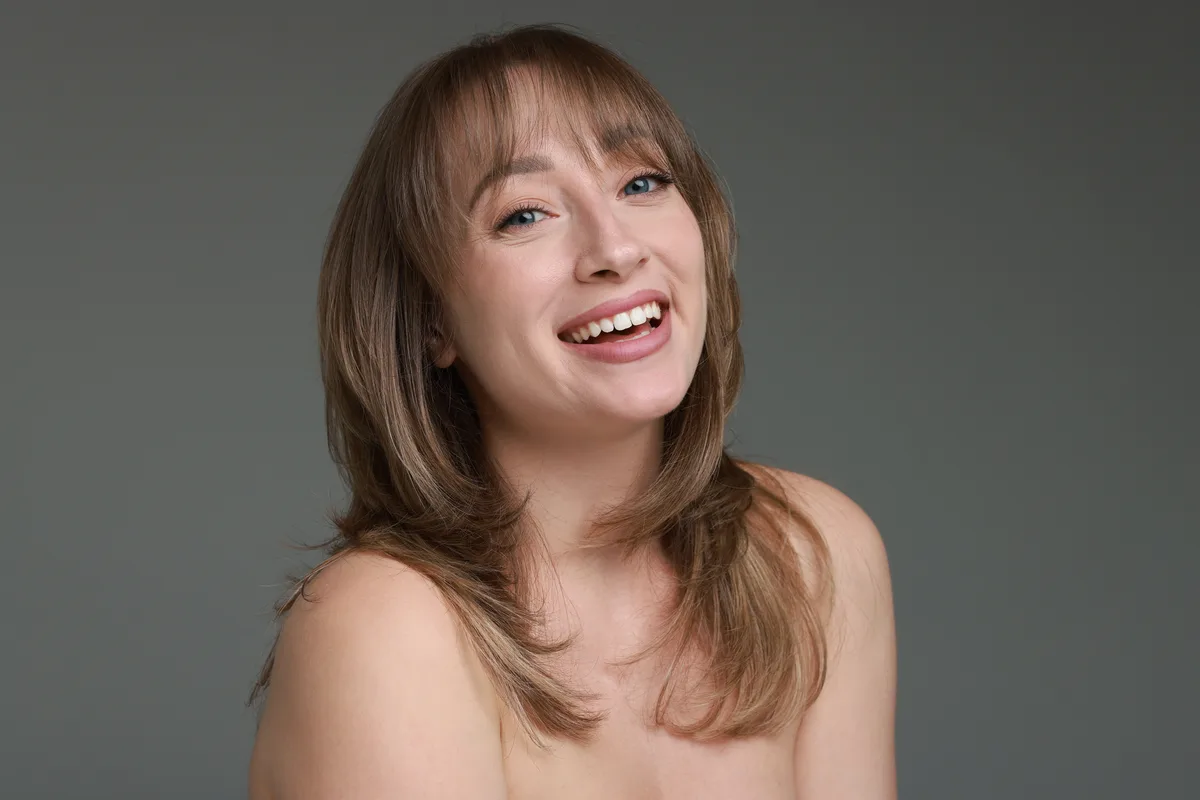
Here the fringe is lighter still — see-through wispy at the centre, with layered shoulder-length hair carrying the same softness down through the ends. The grey studio backdrop shows the shape honestly: nothing heavy anywhere, and the fringe opens the face rather than shortening it. This is the version to screenshot for a stylist if “soft” is the whole brief.
Suits: fine to medium hair; longer and oval faces. Upkeep: low; layers forgive a missed trim. Ask your stylist for: a wispy curtain fringe with long, soft layers and feathered ends throughout.
3. The Separated Brow Fringe, Hair Swept Up

A close-up worth studying: the fringe is separated into fine strands across the brow and noticeably longer at the temples, while the rest of the hair is swept up and away. Those longer temple pieces are the curtain fringe’s signature — they bridge the gap between fringe and hairstyle, so an updo never leaves the forehead looking bare or the fringe looking stranded.
Suits: women who wear their hair up often; warm climates. Upkeep: low; the separation is in the cut, not the styling. Ask your stylist for: a wispy, separated fringe kept longer at the temples, point-cut ends.
4. Featherlight Fringe on Strawberry Blonde

Photographed outdoors in daylight, this fringe is the thinnest in the gallery — brow-grazing, translucent, moving with the breeze. It is the clearest proof that a fringe after 50 does not need density to register: a whisper of hair across the forehead softens the hairline, catches light, and never once looks like a helmet. For women whose hair has thinned at the front, this is the most honest fringe in the set — it works with the hair that is there instead of pretending at more, and because it starts from such a shallow section, the crown behind it keeps every strand it has.
Suits: fine and thinning hairlines; fair colouring. Upkeep: very low; grows out invisibly. Ask your stylist for: a featherlight wispy fringe, minimal density, cut dry so the true length shows.
5. Curtain Fringe with a High Ponytail

The fringe here is worn with a high ponytail in bright sun, and the close-up shows why it works: the centre strands are wispy and broken up, the sides sweep back into the ponytail, and the whole effect is lift rather than weight. For women who tie their hair up daily, this is the fringe that survives the elastic. It also answers a fair question — whether a fringe is wasted on someone who rarely wears her hair down. It is not: the fringe is the part that stays visible, framing the face in every updo, workout and gardening session, while the lengths are safely out of the way.
Suits: active routines; thicker hair that needs the front lightened. Upkeep: low; a fringe trim keeps the centre in check. Ask your stylist for: a centre-parted wispy fringe blended into longer side pieces that reach back into a ponytail.
6. Wispy Fringe on Dark Hair with Silver Streaks

Dark hair with natural silver running through it, tied up, with a thin uneven fringe left loose at the front. The fringe is deliberately imperfect — wispy strands of slightly different lengths — and that irregularity is exactly what keeps dark, strong-coloured hair from looking severe. Silver streaks at the front soften it further.
Suits: dark hair going grey; anyone softening a strong hairline contrast. Upkeep: low; uneven fringes hide regrowth well. Ask your stylist for: a thin, wispy, slightly uneven fringe, point-cut, with the silver left natural at the front.
7. Silver Curtain Fringe at Shoulder Length (AI Visualisation)

This final look is an AI visualisation, labelled as such, showing the version readers request most: full natural silver, worn at shoulder length, with a fine curtain fringe parted at the centre and feathering into the sides. Silver hair is often coarser and drier, and a wispy fringe suits it precisely because it asks for so little hair — the texture reads as softness, not weight.
Suits: fully silver and grey-blended hair; shoulder-length cuts. Upkeep: low; purple-toning shampoo keeps silver bright. Ask your stylist for: a fine centre-parted curtain fringe, feathered ends, nothing blunt at the front.
Before You Book: A Curtain Bangs Checklist
- Bring a photograph from this gallery and point at the fringe density — “wispy like this”, not just “curtain bangs”.
- Say the words “centre-parted, brow length in the middle, longer at the cheekbones” — that sentence is the whole cut.
- Ask for feathered, point-cut ends; a fringe cut in one straight line will grow out severe even if it starts soft.
- Fine hair? Ask the stylist to take the fringe from a shallow section so the crown keeps its volume.
- Plan a fringe trim every 6–8 weeks; many salons tidy fringes free or cheaply between cuts.
- Style forward first, then sweep apart — drying the fringe straight down and hoping it parts rarely works.
Photos: real portraits licensed from Envato Elements under the HairAndGrace project licence (images by projectUA, africaimages, YuriArcursPeopleimages, tanitost and wirestock), with one clearly labelled AI visualisation where noted. Two licensed photos from the original selection were not used: one fringe read straight-across rather than curtained at full size, and one model read younger than this site’s 40–65 standard. Treat every style as inspiration for your own stylist.