

11 Layered Bobs for Round Faces Over 40 That Lengthen and Lift
A round face and a bob are not natural enemies — a badly placed bob is. When the widest part of the cut lands exactly at the widest part of the face, cheeks look fuller and the whole shape reads wider. But a layered bob does the opposite work: the layers break up the outline, the front pieces fall diagonally past the chin, and the eye travels down instead of across. That is why layered bobs for round faces over 40 are less about one magic cut and more about where the length, lift and layers sit.
This gallery brings together 11 layered bobs chosen for exactly that geometry — below-chin lengths, lift at the crown rather than volume at the sides, and face-framing pieces that start high and fall diagonally. Nine are real photographs of women in their forties, fifties and sixties; the last two are clearly labelled AI visualisations, included because they show two placements — the deep side part and the curtain fringe — that stock photography rarely captures on a genuinely round face.
What Makes a Layered Bob Flatter a Round Face
Length placement comes first. A bob that ends right at the widest point of the face adds width where you least want it. Length that clears the chin — sitting just below it, or longer at the front — draws the eye downward and makes the face read longer. Chin-length cuts can still work, as entry 9 shows, but only with soft layers and a side part to break the symmetry.
Lift belongs at the crown, not the cheeks. Height on top lengthens the overall silhouette. Volume at the sides does the reverse, so layers should be feathered or tucked inward at cheek level, never flicked outward there — outward flicks at the cheeks are one of the most common ways a bob widens a round face.
Face-framing layers should travel diagonally. The most flattering pieces start around the temple or cheekbone and sweep down toward the chin. That diagonal line is what creates the lengthening effect; layers that stop and bulk out at the cheekbone interrupt it.
Asymmetry is your friend. A deep side part, an A-line shape that is longer at the front, or one side tucked behind the ear all break the mirror-image roundness. The combination to avoid is a centre part with blunt, equal sides — it frames a round face like a picture frame.
Fringes: swept or curtain, rarely blunt. A side-swept fringe and a long curtain fringe both flatter because they cross the forehead diagonally or open in the middle and fall past the cheeks. A short, blunt, straight-across fringe shortens the face visually and needs an honest caution — it suits very few round faces.
Not sure your face is round? Take a straight-on photo with your hair pulled back. If the length and width of your face are roughly equal, the jawline is soft rather than angular, and the cheeks are the widest point, you are working with a round shape — and every cut below was chosen with that geometry in mind. None of this is a promise of a different face; it is about where the eye goes, and that is a real, visible difference.
11 Layered Bobs for Round Faces Over 40
1. The Crown-Lift Layered Bob
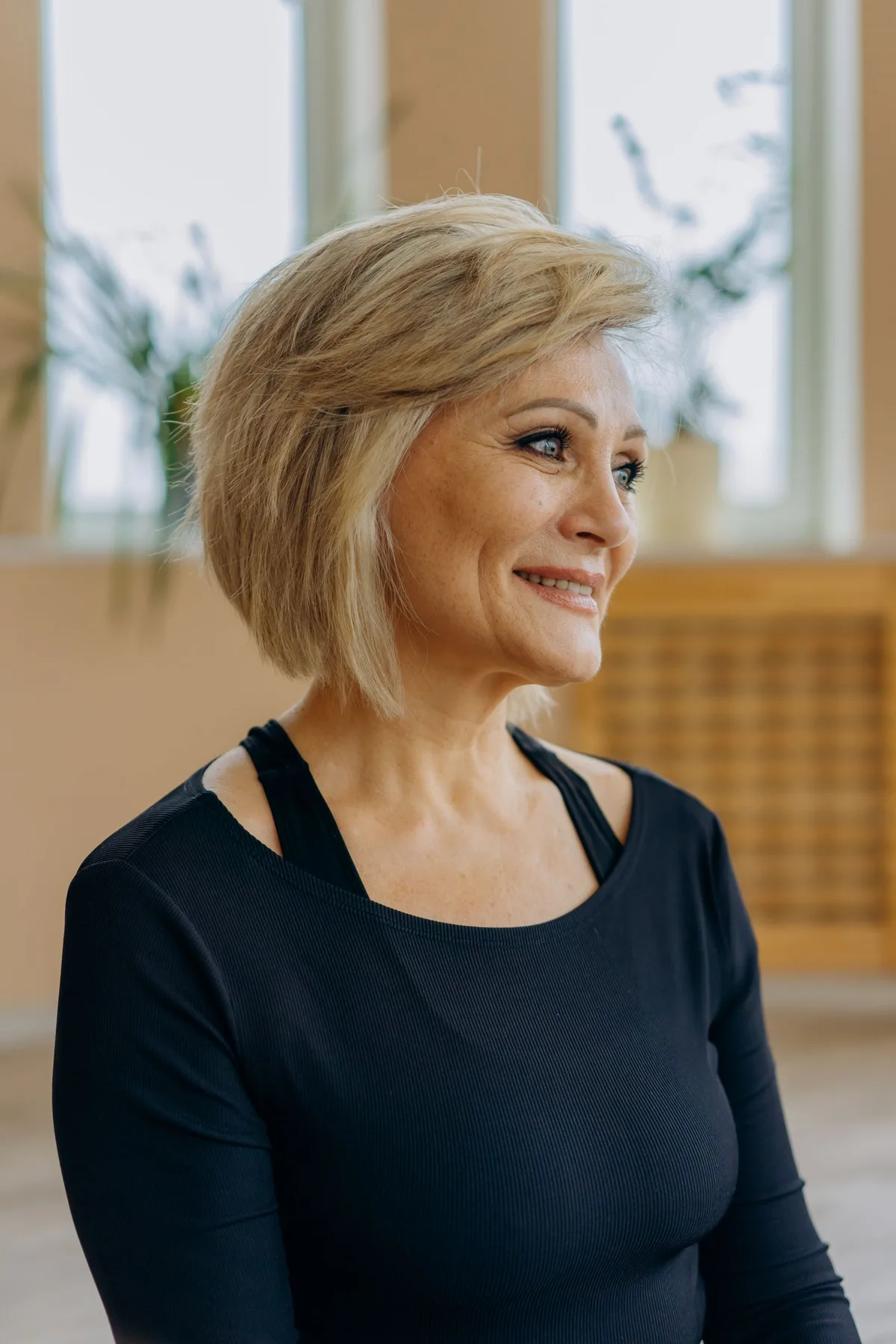
The reference cut for this whole gallery: a blonde layered bob with genuine height at the crown, sides that stay close at cheek level, and front pieces that fall past the chin. Everything the guidance above asks for is visible in one photograph.
Suits: fine to medium hair that needs the illusion of height; the lifted crown is doing the lengthening work. Upkeep: moderate; a trim roughly every 6–8 weeks keeps the crown layers from collapsing. Ask for: a layered bob ending below the chin, with lift built into the crown layers and the sides kept sleek, not flicked out.
2. The Soft Layered Bob with Glasses

A soft blonde bob with gentle layers and a relaxed, natural finish — proof that the cut does not need salon-perfect styling to flatter. The length clears the chin, the sides sit close, and the glasses sit comfortably inside the frame the hair creates.
Suits: glasses wearers and anyone who wants a low-effort, everyday version of the shape. Upkeep: low; this grows out softly, with trims roughly every 8–10 weeks. Ask for: a below-chin layered bob with soft, blended layers and no hard lines, checked against your glasses frames at the appointment.
3. The Feathered Jaw-Length Bob

On a genuinely round face, this dark feathered bob shows why feathering matters: the soft, textured edges stop the cut from forming one solid block of width at the jaw. The short fringe is swept and broken rather than blunt, which keeps it on the flattering side of the fringe rule.
Suits: thick or coarse hair that needs bulk removed without losing the bob shape. Upkeep: moderate; feathered ends want a tidy-up roughly every 6 weeks. Ask for: a jaw-length layered bob with feathered, point-cut ends and a soft, swept fringe — never a straight-across one.
4. The Feathered Lob with a Sweeping Fringe

Seen in profile, this is the diagonal line the guidance section describes: a long, sweeping fringe that starts high and travels down across the cheek, with feathered layers continuing the movement to the ends. Nothing bulks out at cheek level.
Suits: round faces that feel too exposed with hair pulled straight back; the sweep keeps a soft frame at all times. Upkeep: moderate; the fringe needs a quick reshape roughly every 4–6 weeks. Ask for: a layered lob with a long side-swept fringe blended into face-framing layers that start at the cheekbone.
5. The Wavy Layered Lob

Waves flatter a round face when they start below the cheek — exactly as they do here. The top stays smooth and close, the movement begins around chin level, and the layered ends keep the longer length from dragging.
Suits: naturally wavy hair, and anyone who prefers a softer, less “done” finish. Upkeep: low to moderate; air-dries well, with trims roughly every 8 weeks to keep the layers separated. Ask for: a layered lob with waves encouraged from the chin down, and the top section left smooth.
6. The Silver Wavy Layered Lob

The same wave placement in natural silver: layers through the mid-lengths give the waves separation, and the length past the shoulders keeps the diagonal going. A good reference if you are growing out colour and want the cut to do the flattering.
Suits: women embracing natural grey who still want shape and movement rather than a one-length fall. Upkeep: low; silver hair benefits from a purple shampoo roughly once a week to keep the tone bright. Ask for: long layers through the mid-lengths and ends, with face-framing pieces starting at the cheekbone.
7. The Silver Wave Bob

Shorter and more polished: a silver bob where the wave is sculpted rather than loose. The height sits at the crown, the wave breaks at jaw level rather than cheek level, and the profile shows how much length a well-placed wave adds to the silhouette.
Suits: formal dressers and anyone who likes a deliberate, finished style. Upkeep: moderate to high; this shape is styled, not washed-and-left, and holds best with a trim every 5–6 weeks. Ask for: a chin-to-jaw layered bob with crown height, waved under at the ends rather than flicked out.
8. The Sleek Silver Bob

The sleek option: a smooth silver bob in profile, where the flattering work is done by the clean diagonal from crown to chin and front pieces that fall forward past the jaw. No wave, no volume at the sides — just line.
Suits: straight, fine hair that will not hold waves; sleekness is a feature here, not a compromise. Upkeep: moderate; sleek bobs show split ends sooner, so trims roughly every 6 weeks. Ask for: a sleek layered bob, slightly longer at the front, with internal layers only — nothing that adds width at the cheeks.
9. The Sleek Chin-Length Bob — With One Honest Caveat

Chin length is the risky placement for a round face, and this photograph shows the version that earns its place: soft layers rather than a blunt edge, a side-leaning part, and front pieces that curve in below the chin instead of stopping at the widest point. Cut it blunt and straight across, and the same length would widen the face instead.
Suits: round faces with a softer jaw, and anyone set on chin length who will commit to the layers and the side part. Upkeep: moderate; the shape is precise, so trims roughly every 5–6 weeks. Ask for: a chin-length layered bob with softened, curved-under ends and a side part — and ask the stylist to check where the ends land against your cheeks before cutting.
Two More Layered Bobs, Shown as AI Visualisations
The two placements below are the most requested for round faces and the hardest to find photographed on genuinely round faces in stock libraries. Rather than substitute photos of oval faces, they are shown as clearly labelled AI visualisations.
10. The A-Line Bob with a Deep Side Part (AI Visualisation)
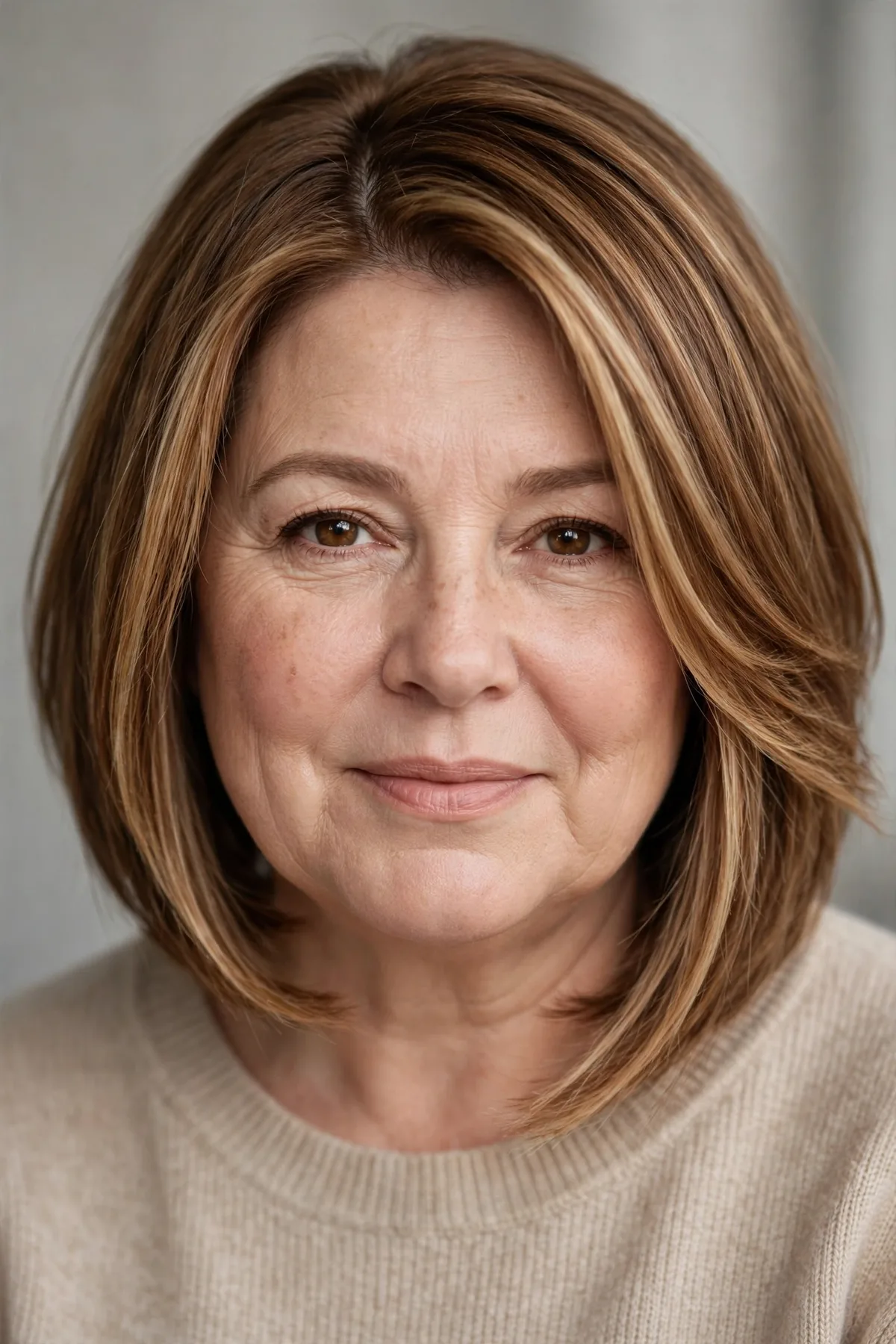
This AI visualisation shows the asymmetry principle at full strength: a deep side part, one side falling diagonally across the cheek, and front lengths that reach past the chin while the back sits higher. The caramel face-framing pieces underline the diagonal.
Suits: round faces that want the strongest lengthening effect a bob can give. Upkeep: moderate; the A-line angle needs a trim roughly every 6 weeks to stay crisp. Ask for: an A-line layered bob, longer at the front, worn with a deep side part — and show this image as the reference.
11. The Curtain-Fringe Layered Bob (AI Visualisation)

This AI visualisation shows the fringe that flatters round faces most reliably: a long curtain fringe that parts in the centre and opens outward, falling past the cheekbones and blending into the layers. The waves, as ever, start below the cheek.
Suits: anyone fringe-curious who has been warned off blunt fringes — this is the safer way in. Upkeep: low to moderate; curtain fringes grow out gracefully and need reshaping roughly every 6–8 weeks. Ask for: a layered bob with a long curtain fringe that opens at the cheekbones, blended into face-framing layers.
Before You Book: A Round-Face Bob Checklist
- Length clears the chin, or the front pieces do — nothing blunt ending at the widest point of the face.
- Lift is planned for the crown; the sides stay close or feathered at cheek level, never flicked outward.
- Face-framing layers start at the temple or cheekbone and fall diagonally toward the chin.
- The part is off-centre or deep to one side; a centre part needs asymmetry somewhere else to balance it.
- Any fringe is swept or curtain-style and long; short and blunt is the one option to skip.
- Thick hair gets internal or feathered layers to remove bulk; fine hair gets longer, softer layers so the shape does not collapse.
- Waves and curls start below the cheek — movement at cheek level adds the width you are avoiding.
Photos: real portraits via Pexels (free to use under the Pexels licence), with two clearly labelled AI visualisations where noted — see the credits on this page. Every cut above is presented as visual inspiration to discuss with your own stylist; the right version for you depends on your hair’s texture, density and growth patterns, which a photograph cannot show.
The shag is layering taken further: see 8 Wolf Cut & Soft Shag Ideas: The 2026 Shag, Adapted for Women Over 40 — feathered layers, curtain fringes and tousled texture for women over 40, with upkeep notes and what to ask your stylist.
Over 60 and choosing between blunt and layered? See 14 Bob Haircuts for Women Over 60 That Look Polished, Not Frumpy — fourteen blunt, layered, silver and brunette bobs with fringe, glasses and upkeep notes.
Want the lob version of these layers? See 15 Layered Lobs for Women Over 50 That Move Beautifully — fifteen layered lobs that move, from flipped ends to wind-tested waves.
For the oval-face version of short cuts, see 13 Short Haircuts for Oval Faces Over 50 — thirteen pixies, chin bobs and fringes that keep an oval face balanced, each with exactly what to ask your stylist.